German media market 2035: why content distribution now decides the future of media companies
5 min read
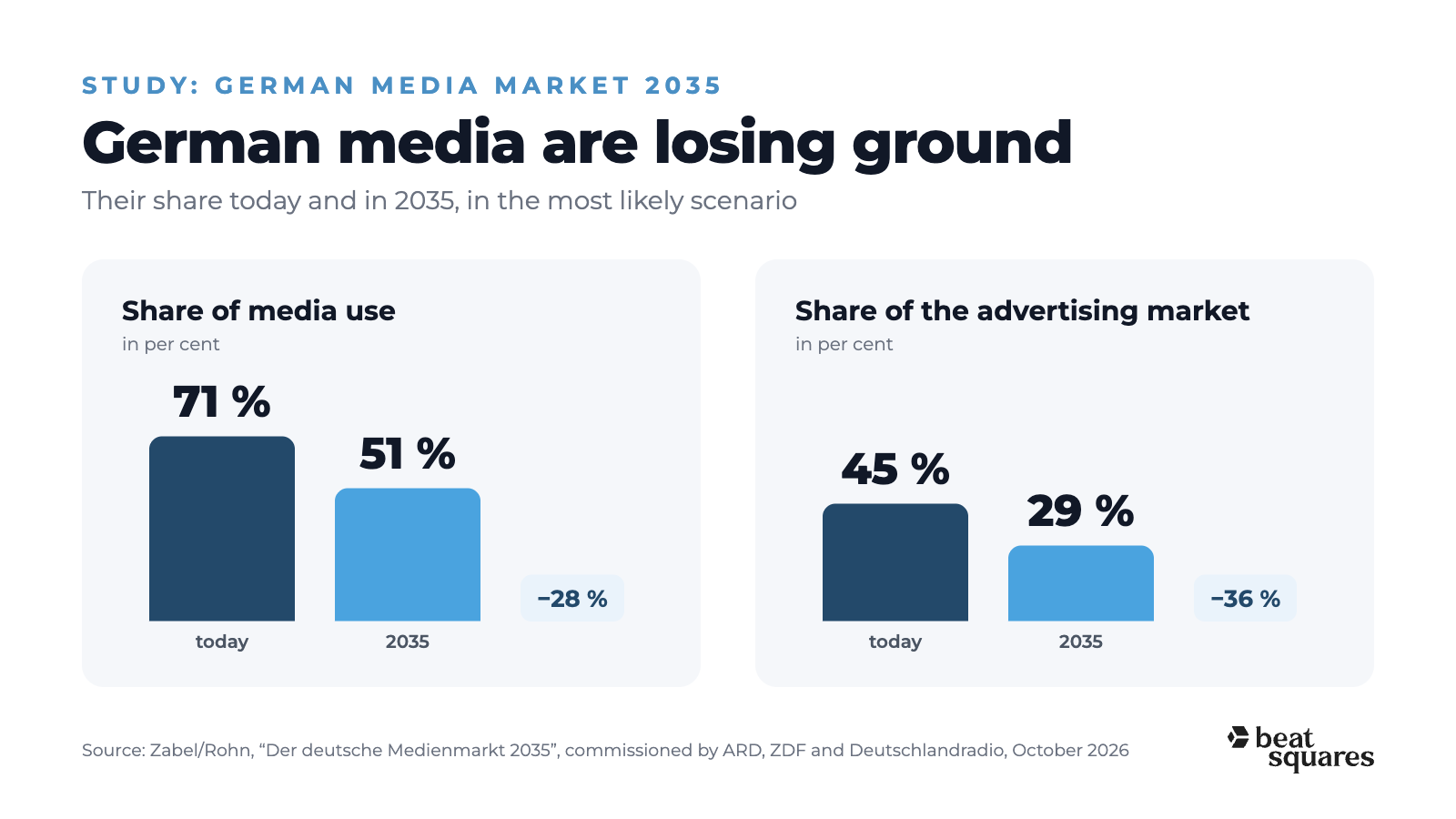
Media companies reach their audiences less and less on their own websites, and more and more on platforms, in third-party interfaces and, increasingly, through AI. Content distribution, meaning preparing content for each channel and publishing it there reliably, is turning from an extra task into a question of survival. A new study, “Der deutsche Medienmarkt 2035” (in German), shows why: in the most likely scenario, German media’s share of the advertising market falls from 45 to 29 per cent by 2035.
The future is open, but it won’t wait
The report was written by media economists Christian Zabel (TH Köln) and Ulrike Rohn (Tallinn University) for Germany’s public broadcasters ARD, ZDF and Deutschlandradio, and presented in October 2026. In the worst case, the industry’s revenue falls by up to 43 per cent.
But the study has a second number. Between the best and the worst scenario lies an economic margin of around 8.5 billion euros (in German), according to the authors. How far revenue falls depends, according to the final presentation (in German), on regulation, on the pace of AI development and on cooperation within the market. Policymakers have a part to play, no question. But much of that margin lies with media companies themselves.
Where is the audience today?
In all four of the study’s scenarios, platforms, third-party interfaces and AI increasingly decide who gets to see which content.
That is not a distant future. According to the Reuters Institute Digital News Report 2026 (in German), an average of 54 per cent of people across the 48 markets surveyed use social media and video networks for news, more than use news providers’ websites and apps. In Germany, social media became the main news source for 18 per cent of people (in German) in 2026, a record.
Only 5 per cent (in German) of people in Germany use AI chatbots such as ChatGPT or Gemini for news, according to the same report. I wouldn’t count on that staying low. Meta’s AI agent Muse, which carries out tasks for its users, reached 10.2 million US downloads in its first 40 days after launching in September 2026, according to Sensor Tower. Only eleven other apps have got there that fast. By mid-October, 2.5 million people were using Muse every day.
OpenAI followed at the end of September with Dots, always-on agents inside ChatGPT. OpenAI hasn’t published user numbers for Dots, but ChatGPT itself reaches 1.2 billion people a week, by the company’s own account. Agents like these search and read on their users’ behalf, and so help decide which information reaches them. Whether it will take until 2035 for AI to become a gatekeeper in Germany too is open to doubt.
At the AI Media Leaders Conference, the message was that journalism has to travel. The study now puts numbers to it.
Why do newsrooms struggle to keep up?
From my time in audience development, I know the problem from the inside. It wasn’t a state of emergency. It was pretty much the normal state of things.
On one side there is fast content: new film releases, deaths, sports results. Every minute counts, and the content has to run across all channels at once. On the other side there is deep content that explains and puts things in context. Add keyword and trend research on top. And all of it with a team in which people fall ill and go on holiday.
When it doesn’t work, a chain reaction follows. Reach drops first on the fast track, especially where a lot of traffic comes from Google Discover or Google News. Over time, content that doesn’t depend on the news gets left behind too. In the end, page impressions are missing, and with them advertising revenue. The study describes the same chain, only on the scale of an entire industry.
What can AI do beyond cutting costs?
Media companies have to save money; that is reality. But the study explicitly calls for AI to be used not only to cut costs but also for AI-native formats and for formats that work in the creator economy.
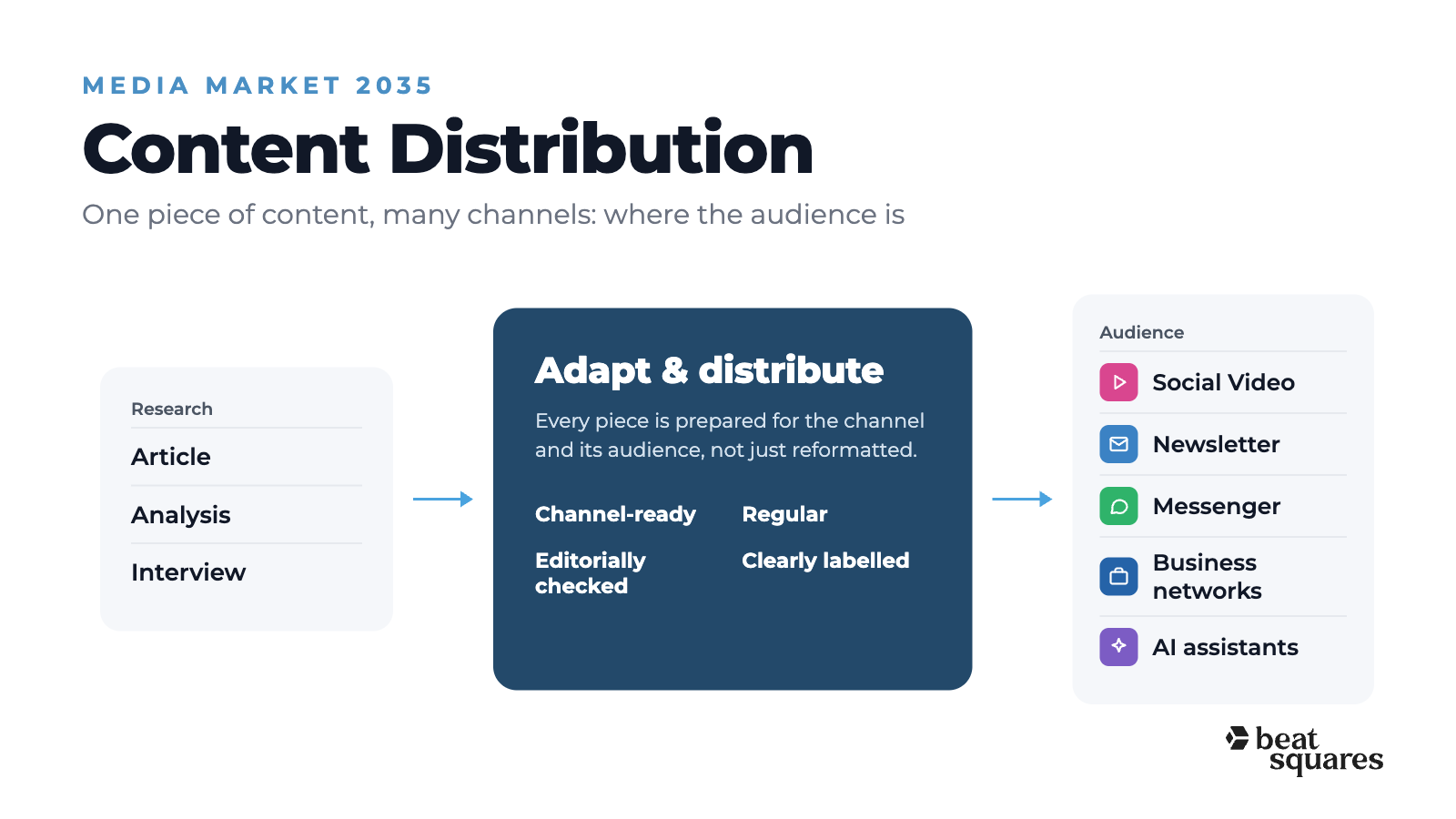
That matches my experience. Many newsrooms aren’t short of skill or ideas. They are short of time to prepare good content so that it works on every channel. With clear rules and editorial control, AI can help exactly here: adapting content precisely, providing it and publishing it regularly. The point is that the content journalists have researched and written so carefully actually reaches people.
At beatsquares we call this Return on Research: research is done once and used many times. The question behind it is how many people it reaches when it appears not only as an article but also as a newsletter, a podcast or a WhatsApp channel.
Why does presence build trust?
Among the study’s most likely trends are “brands as quality anchors” and content authentication. That fits another finding: only 13 per cent of people in Germany say they can trust news on social media and from AI chatbots most of the time, according to the Digital News Report 2026 (in German).
That is an opportunity. Trust comes from reliability. When the outlet I like shows up regularly on my channel, interacts with me and keeps me informed, it becomes a brand I rely on.
Plain repurposing isn’t enough for that. Sooner or later every platform will offer format conversion itself. What matters is that content is genuinely adapted to the channel and its audience, with editorial quality and clear labelling.
What media companies can take from this
The study is no reason to give up, but it is a wake-up call. For decision-makers, now is the time for an honest look at their own set-up:
- Can our team, with the people it has today, reliably serve this many channels?
- Where are we losing time, and where could we gain efficiency?
- How well are the channels we already run performing? And if one isn’t working, why not?
With those answers, it’s worth sitting down with management: do we build our own system? Or are there solutions that already work and help us with efficiency, reach and loyalty?
The study’s favourable scenarios won’t happen by themselves. Content distribution is one of the levers media companies hold in their own hands.
See how this works in practice: book a demo.
Author box: Stephanie Schuricht is Head of Audience Development at beatsquares, where she is building the growth function. Before that she led audience development at Bauer Xcel Media in Hamburg for brands such as Bravo, TV Movie and Lecker, and was previously Head of SEO there. LinkedIn