Stadt_Land im Fluss: Why the future of local journalism needs courage and innovation
5 min read
About the author: Ella Teuscher is Marketing Manager at beatsquares. LinkedIn
Key points: Local journalism has a future when the courage to try new formats meets technology that makes those formats sustainable for small newsrooms, too. Artificial intelligence (AI) is more than a cost-cutting tool here: it creates capacity for on-the-ground reporting and for digital products that would not exist otherwise. That was the lesson of the local journalism award “Stadt_Land im Fluss” on 19 November 2026 in Berlin, for which beatsquares was nominated together with Tagesspiegel.
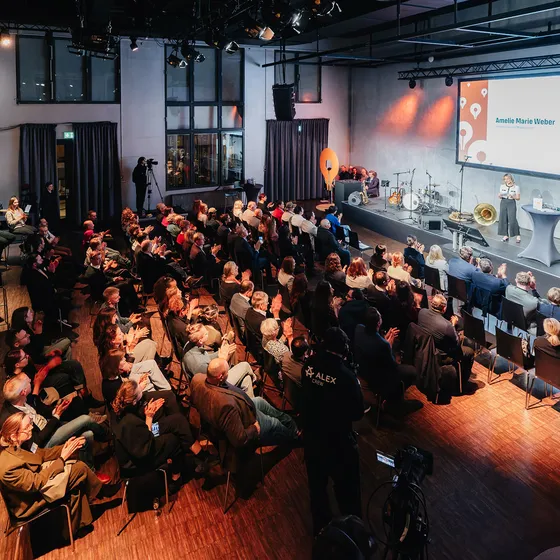
I was at the Kulturbrauerei that evening, and what stays with me most is the mood: hope instead of a eulogy. A room full of people who are not managing local journalism’s decline but reinventing it. The 18 nominated projects from Berlin and Brandenburg ranged from data investigations and youth film projects to new start-ups and local radio. That range shows how great the need is on the ground.
Brandenburg’s economics minister Martina Klement called local journalism “the voice of home” that evening. What inspired me was how many people are finding new ways to make that voice heard every day.
Why does local journalism in Germany need a stage right now?
Local journalism is under pressure. According to the study “Wüstenradar” (“desert radar”) by Hamburg Media School (November 2024), 187 of Germany’s 400 districts and independent cities now have only one independent local daily newspaper; in 1992 that was true of 134 districts. Newsrooms are being merged and local editions are disappearing.
Yet people know what they would miss. In the study “Lokaljournalismus und Demokratie” (“Local journalism and democracy”) by the Bavarian Regulatory Authority for New Media (BLM), 65 percent of 2,069 respondents aged 14 and over (surveyed in July and August 2025) said that without local journalism they would learn less about the concerns of their fellow citizens. In the same survey, 59 percent expect that problems in their region would then go undetected.
A news desert is a region with no local news coverage left at all. International research links strong local journalism with higher voter turnout, less polarisation and more civic engagement, as the study “Demokratie beginnt im Lokalen” (“Democracy begins locally”) by the Heinrich Böll Foundation (September 2025) summarises. Germany does not yet have news deserts at district level like those in the US. That is good news, and the best reason to act now, while the structures are still in place.
What makes the local journalism award “Stadt_Land im Fluss” special?
“Stadt_Land im Fluss” is the local journalism award of the Media Authority Berlin-Brandenburg (mabb) and the Media Innovation Centre Babelsberg (MIZ), funded by the states of Berlin and Brandenburg. It is presented in three categories, each for Berlin and for Brandenburg: Lokal_Pioniere (local pioneers) honours new local offerings that close information gaps, Lokal_Wandel (local change) honours creative, forward-looking ideas for town and country. The Lokal_Innovation category recognises new technical or editorial solutions with a local focus.
According to the trade publication radiowoche, the 2026 winners included radioSKW for “radioSKW erklärt”, the Berlin newsletter loky*, the joint project “Krasse Storys” by lausitz.tv, seenluft24 and Brandenburgisches Fernsehnetz, the data project Windgeld.de by Fabian Dietrich, and Tagesspiegel for “Dann eben noch eine Kaffee-Kette”. Congratulations to all the winners!
I think this combination of pioneering spirit and technology is exactly right. Pioneering spirit alone is not enough if a new format collapses under the workload. And technology alone achieves nothing if nobody on the ground finds the stories.
What were beatsquares and Tagesspiegel nominated for?
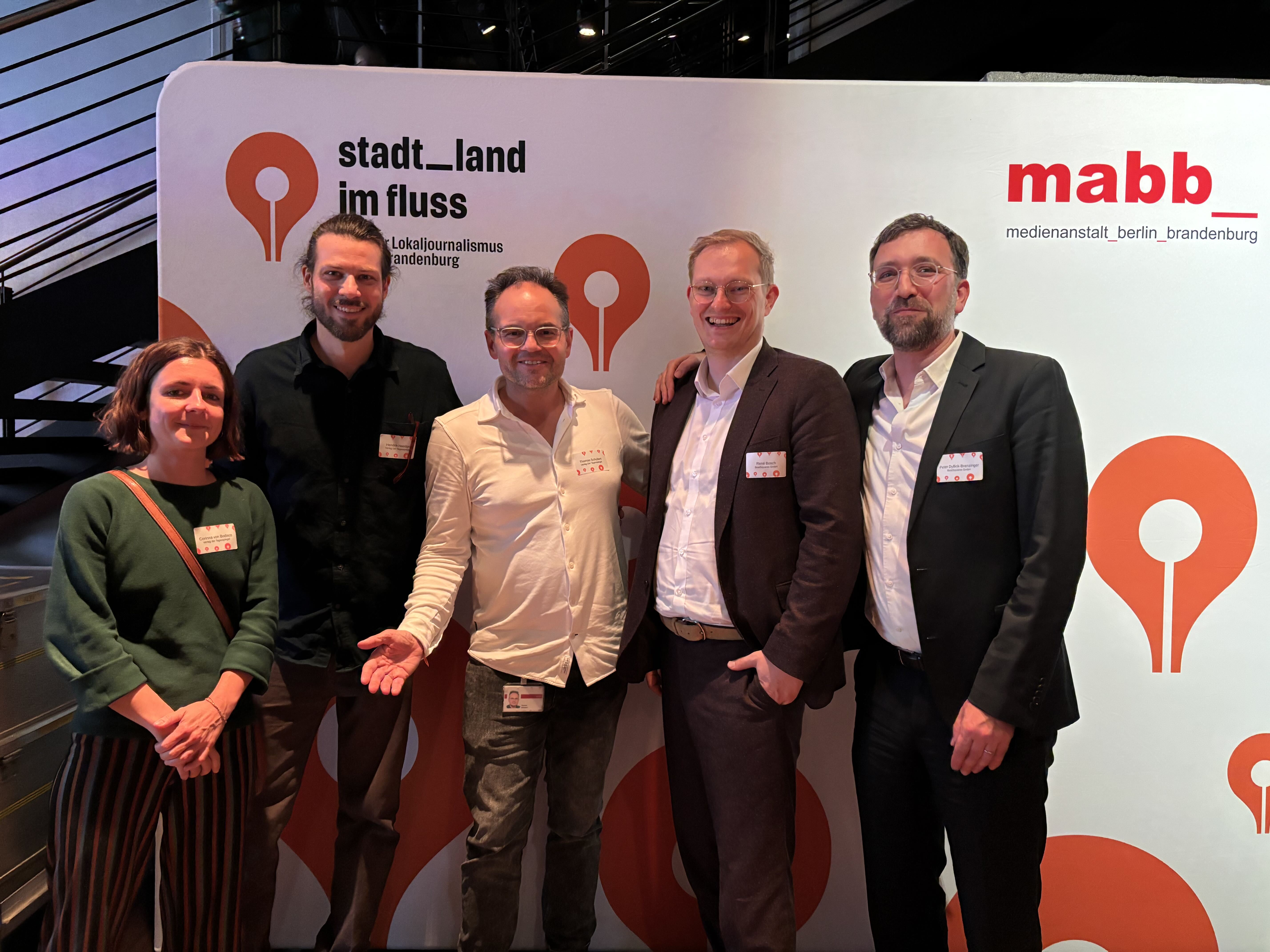
Together with Verlag Der Tagesspiegel, we were nominated in the Lokal_Innovation category for the twelve hyperlocal district newsletters in Berlin. Hyperlocal news is coverage that focuses on a very small area, in this case one Berlin district per newsletter.
Tagesspiegel’s reporters already cover the districts. beatsquares automatically pulls this existing reporting into the newsletters and adapts it to the channel and to the readers in each district. The newsroom reviews and approves.
The result: with beatsquares, each issue is produced in half the time. The time saved goes where local journalism creates its value: reporting on the ground. You can see how it works on our page about premium newsletters in your own layout.
What does artificial intelligence make possible for small local newsrooms?
AI in local journalism is often discussed mainly as a way to cut costs. I see more in it: it frees up capacity, for more reporting and for products that would not exist otherwise.
Large publishers are already using this. RedaktionsNetzwerk Deutschland (RND), a large German newspaper network, runs more than 70 local newsletters by its own account, as its leadership said in September 2026 in a turi2 interview with RND’s editors-in-chief.
For small newsrooms, though, the opportunity is even bigger. They are already set up to report the stories on the ground. What they lack is the capacity to turn that reporting into a dedicated digital product for each audience: a newsletter for the neighbourhood, a WhatsApp channel for the town, an audio update for commuters.
AI makes exactly that feasible, and for small newsrooms it is a real advantage: in my view, large media companies can hardly cover stories with such close ties to specific people in a place in the same depth. The demand is there: in the BLM study “Lokaljournalismus und Demokratie” (2025), 43 percent of respondents want local information by email newsletter in future, and 44 percent via messengers such as WhatsApp.
Where should local newsrooms start with new digital products?
Not with the format, but with the people in the area. Four questions help:
- Who lives here?
- What interests these people, and what drives them?
- What occupies them in everyday life?
- What information are they missing, and how can we best reach them?
Starting this way, you don’t build formats on spec, but products people actually need. And the technology for it is no longer a privilege of large publishers.
The evening at the Kulturbrauerei showed how much courage and how many ideas there are in local journalism. I hope every small newsroom feels empowered to turn that courage into products of its own.
If you’d like to see what this could look like in your newsroom, book a demo.
Thanks to Corinna von Bodisco, Thomas Schubert, Hendrik Haedge and the whole Tagesspiegel team for the collaboration, and to mabb and MIZ Babelsberg for a wonderful evening.