Reducing dependence on Google: why publishers know it and still change course too late
6 min read
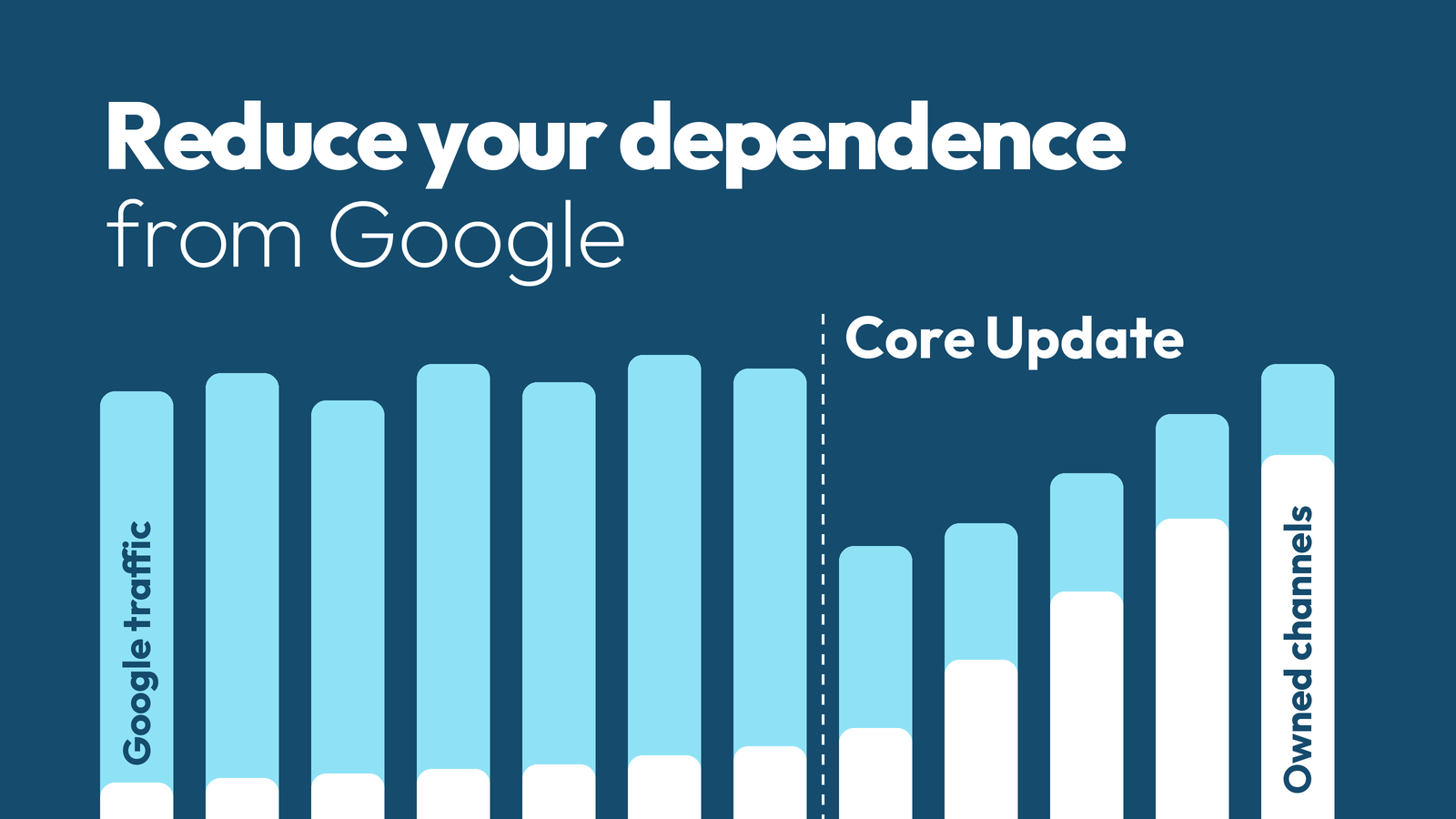
You don't reduce your dependence on Google with yet another analysis showing how dependent you are. Most publishers have known that for a long time. You reduce it with targets that don't punish building your own channels, and with newsrooms you bring along while the old channels still carry you.
That's the most important lesson from my time as Head of Audience Development at a large publishing house. This piece is for everyone who has to push exactly that through internally.
As I write it, Google is wrapping up its November 2026 core update on 24 November and announcing the next one the same day: the December update is scheduled to roll out in December (see the Google Search Status Dashboard). For newsrooms, these are nail-biting moments. You hope, because you rarely see the impact on day one. You need comparison periods, and it obviously helps enormously when the next update is already at the door (irony off). If a large share of your reach comes through your own channels at a time like this, you can wait it out far more calmly.
Why do publishers know about their Google dependence and still not change course?
According to the 2026 trend survey by BDZV and Highberg, a good 45 percent of the German newspaper and digital publishers surveyed are heavily or even existentially dependent on the traffic they get via Big Tech (February 2026). That's news to no one. Anyone responsible for reach at a publisher knows the curves and the worry behind them.
The problem lies elsewhere. It takes an enormously long time to convince larger newsrooms and teams that new mechanisms are the right ones, and to get the numbers to back that up. Meanwhile, the quarter's targets still have to be hit. So people cling to whatever still works instead of thinking ahead.
How tough those targets can be is shown by Reach, the British publisher behind the Mirror. According to Press Gazette, Mirror journalists had personal monthly targets of roughly 250,000 to one million page views in early 2025. With a target like that, nobody voluntarily asks whether a channel will still hold up in two years.
The problem isn't a lack of knowledge. It's the target system.
What happens when you end republishing?
Almost a year ago, we sat down with all the newsrooms and said: republishing the way we've been doing it can't continue.
What we meant was a mechanism many publishers will recognise. An article doesn't take off as hoped, say in Discover or in the news. So it gets published again under a new URL, with the same content. No new headline, no new sections, no new image. I also know of cases where lists of several hundred URLs were republished every single day. Readers get nothing out of it.
For some brands the trick still worked. For those that had pushed it hardest, we saw a clear drop in Discover, in some cases to the point of losing the channel entirely.
I'd love to say everyone saw sense and switched (spoiler: no). The moment the rule was out, the debate about exceptions began. What if this happens? And what if I want to do that? Then came a question of fairness: the brands that stuck to the rule rightly wanted everyone else to stick to it too.
The strongest resistance didn't come from those where the trick had stopped working. It came from those where it still worked.
What helped was explaining why we were doing it and offering alternatives. Together with the newsrooms, we checked whether a piece had genuinely got better: a new image, more value, a real reason to show it again. And we used the date fields in the CMS to signal a genuine update to Google cleanly. As always in SEO, the effect didn't show after days or weeks but over months. For some brands, fortunately, it came back.
Why does the fall come faster than expected?
My experience isn't an isolated case. Line up public cases side by side and you see the same order: publishers change their metrics, but only after the crash.
| Publisher | What was measured | What happened | New direction |
|---|---|---|---|
| Reach (incl. the Mirror) | Personal page-view targets per journalist (Press Gazette, January 2025) | Google referrals −55% (half-year results, July 2026) | “Active engaged time” to become the key metric by year-end, above page views (September 2026) |
| Daily Mail (DMG Media) | “Every dashboard in the newsroom was page views,” product chief Lewis Buttress told Digiday about his start in early 2025 | Around 37% fewer visits than in March 2023 (Similarweb estimate, March 2026) | Time on page, return visits within seven days and an in-house “golden metric” |
| RND (Madsack, Germany) | Up to three in four visits by paying users came via channels the company doesn't control | According to Denni Klein, a single Google update was enough to wipe out reach, sign-ups and revenue across the industry | “Abo First” (subscriptions first), 1.1 million newsletter subscriptions (turi2, September 2026) |
At Reach, the switch came alongside a net cut of around 160 editorial jobs. Denni Klein, co-managing director of RedaktionsNetzwerk Deutschland, put it this way in an interview with turi2: “Time is running out on us fast in this transformation.” (translated from German)
That matches what I experienced. If you focus on certain channels for too long and wring them dry, the fall comes much faster than you think and hits much harder.
“But reach pays the bills.” Is that still true?
It's the strongest objection, and it's meant seriously. Jim Mullen, then CEO of Reach, told his staff in 2024, according to Press Gazette: “I need to get the page views. That is the way we sell advertising blocks, and advertising blocks deliver revenue.”
I get that. But when more than half of your Google traffic disappears after an update, those page views stop coming too. In the first half of 2026, Reach earned 49% more per thousand page views. Digital revenue still fell by 11%. Better monetisation per page doesn't make up for missing volume.
That's why I don't want to abolish page views. They remain a useful guide. What matters is the balance: how many of your page views come through channels you control yourself, such as newsletters or WhatsApp channels? That's the share you need to build before the next crash.
What can you do differently on Monday?
- Dig deep into your data. How much of your reach depends on a channel you don't control? Set your priorities accordingly, not by what still happens to be working.
- Bring your newsrooms along. Offer regular learning sessions where you explain why something no longer works and what the alternatives are. And settle exceptions before the fairness debate starts.
- Build your own channels while the old ones still carry you. Newsletters and WhatsApp channels catch page views that are falling away, or bring the same content to your readers in a different form.
Conclusion: change course while it's still your choice
Publishers have long known they depend on Google. What stops them from changing course is the pressure to hit today's targets. The winners will be those who bring their newsrooms along and build their own channels while the old ones still carry them.
At beatsquares, this is exactly what we work on: content a publisher already has becomes newsletters and WhatsApp channels in the publisher's own tone and design, checked and approved by the newsroom. Here's how that works for publishers and media houses.
Over to you: which trick is your publisher still keeping alive, even though everyone knows it won't last much longer?
Author box: Stephanie Schuricht is Head of Audience Development at beatsquares, where she is building the growth function. Before that she led audience development at Bauer Xcel Media in Hamburg for brands such as Bravo, TV Movie and Lecker, and was previously Head of SEO there. LinkedIn